


Updated: Mar 6, 2022
Hiking in the Brooks is one of the few places on earth where one can still get a sense of what it was like to explore country as humans did in pre-map, pre-GPS, pre-Google Earth ages. Because there are few if any trails up here, hikers must read the landscape as much as maps.
This past week, my friend Josh Spice (not to be confused with my other friend named Josh) and I planned a two-day hike up Nutirwik Creek in the Central Brooks Range, just a few miles south of the treeline. We had plans of following drainages, climbing mountain passes, and hopping onto wide river valleys.
Our plans, though, fell apart within the first hour. You’ll see why.
Here’s a picture tour of our hike. (Most of these photos were taken by Josh. He also sold me his Sony TX-5 for $150, so I’m happy I can once again take photos while I’m up here.)
Here I am on Nutirwik Creek. We’d planned to walk up to the headwaters and over a mountain pass.

But from afar we could see that the creek narrowed considerably.

What to do now?

We wanted to continued to follow this creek since it led to the Chandalar River. So we needed to get around the waterfall. So we, uh, decided to climb the mountain to our left. (Which is a decision that didn’t seem as stupid and badass as it looks in the pictures below.) Here I am climbing.

And here’s Josh, who–an overly dedicated photographer, one could argue–refused to pack away his camera, forbidding himself the luxury of a second hand. “This is definitely ‘sketch,'” he yelled to me as he carefully watched his purchase on the rocks.

Can you espy Josh?


Finally, we made it a comfortable spot near the top. Some views of the Brooks Range.

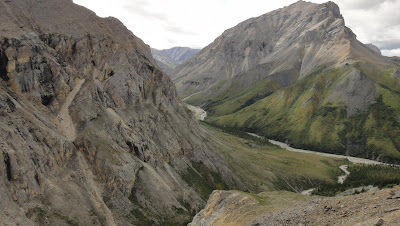
We wanted to get back on the creek that had the waterfall, so we walked east on the side of the mountain on a Dall Sheep trail.


And then we realized that there is another, potentially impassible gorge that will prevent us from getting back on the creek.

We hike to the bottom of the gorge, hoping that we could reach the creek from boulder to boulder.


But then we came across yet another waterfall, except this time we were standing above it. With no other option, we climbed the mountain in front of us again.

Finally, we made it back onto the creek valley. This is called “Warm Water Creek” because there’s a natural spring that shoots out 50 F degree water throughout the year.

Easy walking now. Weather got crappy, though, so here we are in our rain gear.


And finally we made it out to the Chandalar. This area is called Chandalar Shelf.

Josh is obsessed with ultra-light backpacking. (On the way, he gave me a 45-minute dissertation on the virtues of both down and synthetic sleeping bags. (It’s a complex subject, supposedly, because by minute 40 I still had no idea which was better.)) His tent weighs something like a pound and it’s held upright with his two trekking poles.


I was a little wary of sleeping it in because there’s no bottom to the tent. I don’t care too much about getting wet or cold, but I was reluctant because mosquitoes could get in through openings on the bottom. And sure enough, in the middle of the night, I woke up on several occasions, with two of them fat and plump on my nostril, needling their little probosces through my skin. Eventually, I had to don my bug hat for the rest of the night. Josh’s face, when I looked over, was, curiously, left unperturbed.

The next day we walked to the road. Here we are walking on the pipeline, which, in parts, is underground. We walked 10 miles south on the Dalton Highway back to his vehicle and then drove back to Coldfoot, home sweet home.

Updated: Mar 9, 2022

I’m excited to report that my best friend, Josh Pruyn (who’s been mentioned a dozen or so times on this blog), is at the center of a national “scandal.“
Let me back up and give you Josh’s story (which is, in many ways, my story).
I’ve known Josh for about 22 years. We go back to when we played in the same youth ice hockey league at the age of six. A couple years later, he moved into my suburban neighborhood where we played street hockey on an almost daily basis after school for the next ten years. (I challenge any duo in the world to beat me and Josh in a street hockey match.) I’d say we became best friends late in high school when we used the newly discovered “email” as an outlet to complain about our unremitting sexual frustrations.
We dormed together for a year at Alfred University. He stayed and I transferred, but we kept in touch via email, still mostly complaining about our unremitting sexual frustrations. But we also began to discuss other, more substantive things: nature, religion, morality, politics, goals, dreams, failures, insecurities. Everything. I don’t know how many emails we’ve sent to each other since our late teen years, but from 2005 until today we’ve sent a total of 1,750 emails to each other, which averages out to sending and receiving an email every 2.5 days. (I know, it’s a little weird.)
I left college with $32,000 in debt and a history and English degree. He left with $66,000 with a history and political science degree. Needless to say, we no longer complained about women anymore. Our debts were the only things on our minds.

(Me drunkenly embracing Josh on my 21st b-day.)

(Josh came up to work up in the arctic for a bit. Together we burnt and then hauled the Yukon River Camp’s summer garbage down to a dump in Fairbanks.)
I got a job with Coldfoot and, later, the Park Service. Josh, too, tried to enjoy the itinerant lifestyle, jumping from job to job for a while at places like Coldfoot. But because there were huge gaps in between his seasonal employment, Josh had trouble keeping up on his loan payments, which were far more demanding than mine.
He needed something more permanent, so he moved to Denver and took a job as a “admissions representative” with an online for-profit school called Westwood. At first, Josh was excited to be working for a college. He figured he’d be inspiring young people to go to school and improve themselves. (His job, essentially, was to get prospective students to sign up for classes.) But the more he learned about Westwood, the more he found himself in a moral quandary.
Here’s the thing about most online for-profit schools… They’re mostly a scam. They often cost around $70,000 for a three-year degree. Because they’re nationally-accredited (which is very different from a regionally-accredited school), students cannot transfer their credits to normal universities. And most employers don’t take their degrees seriously, so they can’t get jobs, either. Places like University of Pheonix and Kaplan and Westwood are putting many many young people in terrible, terrible debt that they can’t get out of.
Josh, as an admissions rep (which made him little more than a glorified telemarketer), began to see what was going on around him. Many of his fellow coworkers were lying to or misleading prospective students. Those who got the most students to sign up were rewarded with vacations to Cancun, parties, bonuses… At an employee celebration, one coworker laughingly received a “Best Liar” award. Those who didn’t sign up students were fired. It was cruel irony that, to pay off his debt, Josh was now in the business of putting other young people into debt.
After five months, Josh ended up quitting. This is where I come in (and where I play a very minor role in this narrative).
I moved to Denver to stay with him and his girlfriend for a couple months (right before I bought a van and enrolled at Duke). After hearing Josh’s horror stories about Westwood, I wanted to publish an exposé on the school’s unethical practices. I wanted to bring Westwood down. (It was an unrealistic goal, as I’d published just a few very minor professional articles at that point.) I spent a couple months emailing ex-professors, ex-students, and ex-administrators from Westwood. I wrote a great article, but no one wanted to publish it (which frustrates me to this day).
While researching, I discovered a law firm that was representing former Westwood students, who were suing the college. I got some info from the lawyers and told them about Josh. They began talking with Josh. Josh told the lawyers the many gory details about what happens on the Westwood sales floor.
So when Senator Tom Harkin (Democrat/Iowa), who was conducting a hearing about the crimes of for-profit trade schools, found out about Josh and his experiences at Westwood, Harkin asked Josh to testify in front of the Senate.
Josh flew to D.C and, last fall, delivered his testimony about Westwood. It was his shining hour, his redemptive moment. (To watch Josh, fast forward to minute fourteen.)
Let me fast forward to the present day. The Daily Caller a conservative online newspaper founded by journalist and dweeb Tucker Carlson, has printed an exposé on Josh and Senator Harkin, claiming that Harkin and his staff “supplied an answer” to Josh. For some delusional reason, people representing Westwood claimed that Josh was working for the law firm that was suing the school—a bullshit tactic employed to hopefully discredit whatever Josh had to say at the Senate testimony. Needless to say, Josh has no connection with the law firm. Josh merely wanted to expose Westwood’s bullshit. He wanted to do the right thing. When Harkin’s aide advised Josh via email, the aide was merely reiterating what Josh had told him. (PS: I’m the “freelance journalist friend” mentioned a couple times in the exposé.)
You’d think that being at the center of a national controversy would be stressful and chaotic for someone like Josh, who now has a big, ugly, warty evil corporation breathing down his neck. But for the most part, he and I couldn’t be more amused with the whole thing. Josh is still in student debt, so he really has no money or valuable assets that Westwood can take. Plus, he’s right, and Westwood (and The Daily Caller) is wrong. Plus, it’s fun to think back on when we were a couple of losers in high school who’ve each had our fifteen minutes of fame.
Updated: Feb 23, 2022

For a little over a month, I’ve been Coldfoot’s writer-in-residence—a title I use reluctantly because I’ve actually done very little writing on this blog in that timeframe. I’ve mostly been writing my book. And when I say “I’ve mostly been writing my book” I mean: “I’ve mostly been procrastinating writing my book.”
Confession: I am a master procrastinator. And I don’t mean that in a funny, cynical, sarcastic way. I could teach classes on how to procrastinate. A procrastinator who knows what he’s doing knows how to procrastinate efficiently. When I have something important to do, I find myself unable to do the important thing, yet I am exceptionally good at getting secondary, semi-important things done.
So just exactly what have I been doing? I have indexed my whole 140-page “quote collection,” which is on a single-spaced Word file. To retain the insights and ideas from the books I’ve read these past three years, I’ve been collecting and saving quotes in this file, typing out each interesting passage that I think might be of some use to me in the future. Before I indexed them, my collection was little more than a confusing, unorganized jumble of words. I’ve taken it upon myself to, this summer, read every single quote and assign to each an index heading (i.e. “wilderness,” “travel,” “agriculture,” etc.) to be placed under its proper index heading on a separate document.
While I was working on my index on my laptop, one of my female coworkers asked me “how’s the writing’s coming?” I said I’m not writing but that—with no shortage of pride—“I’m just indexing 140 pages of wisdom,” adding that these quotes represented all the topics under the sun that are “the most important to me.” I wanted to impress her with my diligence, so I opened up the index file on my computer, and, on the top of that page—in large, emboldened, 20-point font—was the word “MASTURBATION”—one of several hundred index headings. For the record, “masturbation” is not a topic that I consider of the utmost “importance” to me, but I decided to give it its own section because Jean-Jacques Rousseau has some curious opinions on the matter that I desired to preserve. (PS: If anyone wants a copy of my index, let me know via email and I’ll be happy to send you one. I’ll be done with it in about a week.)
I’ve also gone through 112 pages of my book’s “scrap file” on which I’ve pasted hundreds and hundreds of passages of crappy writing that I wanted out of the book, but didn’t have the heart to delete because it had some value to me. I’ve culled this file down to 79 pages and reorganized every passage under the appropriate chapters so I can easily reincorporate passages into the book if I choose to.
And when I ran out of things to procrastinate, I finally buckled down and edited my first seven (of twenty) chapters.
Another confession: Before I undergo an editing session, I read a chapter of Elizabeth Gilbert’s Eat. Pray. Love., which—I’m embarrassed to admit (as a young, straight male)—is a masterfully written travel memoir that I really, really like. And because I’m in the business of writing a travel memoir, I figured I ought to learn from the best. There are few authors who are able to come across as both sincere and self-deprecating, who make you laugh and cry. Gilbert’s one of them. It’s an incredibly difficult balance to strike—being both stupid and serious—but it’s a magical thing when a writer pulls it off. And by reading her book, I’m able to “Gilbertify” my own words, helping me express ideas colloquially without dumbing anything down.
The real reason I haven’t been writing on this blog is because I’ve been bummed out lately—I’ve been bummed out for quite a while in fact. And while sharing bummed out stuff—which is normally juicy stuff that is sometimes the most fun to write and the most enjoyable to read—I’ve decided to withhold my petty troubles from you, dear reader, because my troubles, currently, aren’t of the interesting sort.
Mainly, I’ve been stressed out about the book: Is it going to happen? Am I just wasting my time? Is my story even worth telling? What am I doing sixty miles north of the Arctic Circle? And while I have tons of reasons to moan about my previous literary agent (who stopped responding to my emails), I’m just not going to go there, as complaining about your agent is just one short step away from whining about my assistant Brant who got me a soy latte when I specifically asked for a Caffe macchiatto. In other words, these are boring, privileged travails—not the sort of travails I want on a blog that I’d like to be about travel and adventure and poverty and journeying and important stuff.
And while I’m still very unsure if the book is going to happen, I am pleased to report that I’m beginning to drub up interest with literary agencies. So we’ll see. I plod on.
***
I just told someone the other day that “I love being unemployed.” It’s not exactly true that I’m unemployed, as I work about eight hours a week, and last week—because a guide had gone on vacation—I worked close to thirty, allowing me to bring in about $500 between salary and tips—but, for the most part, yes, I am unemployed, and goddamn, do I love being unemployed.
“Unemployed” is probably not the best way to describe my current status because I most definitely am employed with book-writing (when I’m not procrastinating it), so I suppose I mean: I love being self-employed. I love working on projects of my own creation; on a schedule that I’ve devised. When work is fun (which the book is for the most part) work is no longer work. Work and leisure become one and the same thing.
As much as Ken the wannabe scholar likes writing, Ken the wannabe wildman feels ignored. Truth is, I’ve spent most of the past three years sitting on my ass in front of a computer. And while I’d rangered for a couple summers and farmed a little bit, I was, for the great majority of that time, sitting on my ass, too. (My ass, as I type this, is quite literally sore from being planted on a chair for so long.)
I’m convinced that 18-year-old Ken (who played on his varsity hockey and football teams) could kick 28-year-old Ken’s ass. Which is kind of sad to think about because I could easily be at my physical peak today if I wished to be. And I guess I’m starting to think that I ought to take advantage of my youth, and go on some once-and-for-all limit-testing physical adventure and use my body to do things I know I won’t be able to do in twenty years. In other words, I want to get off my ass and do something. I want to finish this damn book.
Plus, I find that the whole memoir-making process is kind of fucking with my memory. Let me explain… In order to write a memoir, you must first take actual, real-world experiences (like hitchhiking with a driver in Virginia) and then translate that experience into words that are arranged on a page. (This is the first time you tinker with your memories.) What goes onto page, of course, will never be a perfectly accurate rendition of the original experience because the event that actually happened and your memory of that event are two very different things. Then you have to rearrange those experiences—which are now on page—so that they make sense and are interesting to your reader. For instance, I’ve had to cut important people in my life out of the book because they don’t contribute to the central narrative, or I’ll have to play around with dates a little bit so as to create moments of suspense. (This is the second time you tinker.) Here’s the F’d-up part: I find that now, when I think of my actual experiences, I no longer think of the actual experience; rather, I think about how I’ve rearranged it in my book. I am disfiguring my memories. I suppose this stinks because I no longer see things the way in which they actually happened, but in a weird sort of way, I think I am restructuring my memories in such a way that makes my “story” make more sense. I once heard that all we are are our stories. While my story may no longer be real (and remember no one’s story is perfectly real because all memories are imperfect), my story, now that it’s been disfigured, is better than ever.
All in all, I feel like I’m living in the past. I’ve been writing my story for, off and on, eleven months, and I feel like I can’t move on and can’t create new memories until the book is published. It’s not that simple: I am meeting new people and seeing new stuff up here and having new experiences, but I am far from fully living. After this book, I think I’ll be emptied of stories, yet more than eager to fill up on new ones.