


Updated: Mar 4, 2022


I was once a voyageur. It all started at the 2006 Alaska Tourism Convention in Valdez. I’d been working at Coldfoot Camp at the time, and my boss asked me if I wanted to go with him and a few other tour guides to the convention for a short vacation of sorts. One of the presenters was Bob Abrames, a former CEO of a tour company, a traveling motivational speaker, and a lover of voyageur history.
The voyageurs were Canadian traders of the 18th and 19th centuries who’d haul equipment to the frontier in the west and bring back furs to the villages in the east. In 2005, Bob had the great privilege of joining the “Destination NorOuest Expedition,” which was a 100-day expedition along Canadian rivers and lakes filmed and produced by a French-Canadian film crew. He enjoyed the 2005 voyage so much that he bought a couple of birch bark canoes and started putting together expeditions of his own. At the convention, during his speech, he said he was looking for voyageurs to accompany him on his 2007 expedition–called the “Étienne Brûlé Expedition” during which he and three others would paddle the historic waterways of Canada for two months and 1,500 kilometers.
At the time, I was a recent college grad paying off my debt. Because I hadn’t ever been on an adventure–minus a road trip to Alaska and a couple of small hikes in the Brooks Range–I was pretty excited about the prospect of joining him. I walked up to Bob after the speech and said, “Bob, I’m your man.” Lots of other attendees said something similar, so he more or less forgot about me. But over the next 3-4 months, I pestered him with emails and began a rigorous workout routine to show him how serious I was. Eventually Bob gave in and said I could come.
We had two small birch bark canoes, ideal for a 4-person crew. But because Bob could only find two steady canoemates (myself and Jay), we had a fourth *random* person jump in every other week or so.
Here’s Jay, a retired French teacher and voyageur enthusiast, who was my canoemate for the great bulk of the trip.

Here’s Christian. He starred in the original 2005 DNO expedition with Bob. For personal and professional reasons, he couldn’t accompany us the whole way, but he did spend about 3 weeks in total with us.

Art, who joined us for a week.

We began in Ottawa, Ontario. We head down the Rideau Canal, across the northern rim of Lake Ontario, up the Trent-Severn Canal, then up Georgian Bay, then along the French and Mattawa Rivers, and finally back down the Ottawa River to Ottawa, our starting point. We would try to average 32 kilometers a day, which was no simple feat considering how slow and leaky birch bark canoes are, which were hand-crafted my a master craftsman in Quebec, John Zeitoun.


Here’s Bob and his son Casey, who joined us for part of the expedition. Bob funded and provided provisions, like the canoes, communal gear, and food. We were expected to buy our own clothes, paddle, and personal gear, which we bought from reenactment stores.


Bob and his sister, Sue, another replacement.

Lots of lounging in between hauls. Here we are at a canal lock.

French River, I think.

All our gear was “period-correct,” meaning that we carried and wore the stuff and material that the voyageurs of the 18th century would have used (cotton and wool clothes, leather moccassins, straw hat, etc.) There were a few exceptions, like a camera, a cell phone, gps, and personal flotation devices we wore around our waists, which are required by law. We drank straight from rivers and lakes, but around cities and towns we purified our water with iodine tablets.


At night we’d store all our stuff under the canoes.

I was the unofficial cook and baker of the crew. Here I am making bannock in a couple of frying pans, which were greased with lard.

We slept with wool blankets above a hard cotton ground cloth. Our tarps were made with “egyptian cotton,” which kept us dry, but were quite leaky by the end of the trip.

I am an exquisite napper, able to fall asleep in almost any circumstance, which I’d have to do to make up for all the sleep I lost at night because of the mosquitoes, which we had little protection from. Here I am lying on my ground tarp. My wool blankets are drying off in the distance.

Our fires were started with flint and steel. We’d catch the spark in something called “char,” which is burnt cotton. We’d then shove the cotton into cedar shavings. Blow the shavings, and you have fire.


Diane, also a member of the original DNO crew, giving me a back massage.


Our other meal was salt pork and pea soup, which we ate for breakfast, lunch and dinner every day, and which I’ve never eaten again and probably never will. We also had salt, pepper, tea leaves, maple sugar, and dried cranberries.


Salt pork.

My bannock masterpiece.

We spent a whole day in a swamp called “La Vaz,” which means “the mud” in French. (Correct me if I’m wrong, Francophiles.)

At a designated spot on the Ottawa River, it used to be the tradition for voyageurs to baptize new voyageurs. Here we are walking to the spot, rum cups in hand.

The vows that a voyageur makes at his baptism:
1. To obey the leader of the brigade. 2. To baptize any new voyageur at this point. 3. To not kiss any other voyageur’s wife without her permission.

We carried our stuff in “bed rolls,” which was all our stuff rolled up, which functioned as our seat in the canoe. Here’s Jay, dropping his.


We had numerous portages during which we had to take two trips: the first with the canoes; the second with our bedrolls.
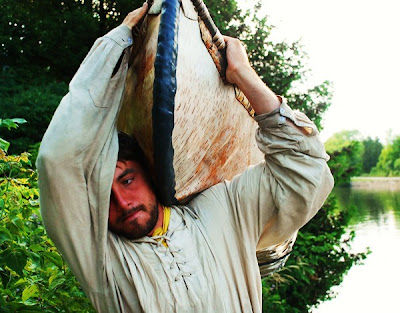
We carried our gear with “tumplines,” which are leather straps that tie around your gear, and then your forehead. It feels about as uncomfortable as it looks in the picture below, though our portages were always a nice change of pace, because one’s ass gets awfully sore in the canoe.


We completed the 1,500 km trip in two months, finishing in Ottawa, where we got a little press in the local newspapers.


Updated: Mar 7, 2022


In June 2011, my friend Josh Spice and I went on a pilgrimage to the “Magic Bus” of the Stampede Trail made famous in the book and film, Into the Wild. Every since then, I’ve been trying to publish an article I wrote about our trip–which is also about how the bus has become a major pilgrimage destination and how the locals despise the pilgrims, yet also profit from them (it really was a good article)–but I’ve been unable to sell it, so I thought I’d finally share the photos of the trip on the blog. (Note to aspiring writers: Even if you have a book deal, a couple of popular magazine articles under your belt, and a great idea for an article, it’s still effiin hard to get magazines to print your stuff.) I’m still holding out hope that I can sell it–otherwise I’d just post the story on here–but until then, here are some pics and observations. (Thanks go to Josh Spice, who took about 95% of the photos.)
Observation #1. The trail is a mess. There are ATV and Jeep tours along the Stampede, and the locals ride giant mudboggers along it, plus any other motorized device imaginable. Consequently, I spent 1/5 of the trip with my feet in water or mud. Tip for future hikers: Don’t bother going through the hassle of keeping your feet dry; you’re bound to get soaked up to the knee.


Observation #2. Gosh, it’s pretty out there. The Stampede Trail runs north of the Alaska Range and the border of Denali National Park. The trail is mutilated, but the scenery is stunning.


This is lupine, I’m pretty sure.

Observation #3. The mosquitoes, like most anywhere in Alaska, are terrible. You can expect for there to be hordes of mosquitoes anytime between mid-May to mid-August. (I have no picture of mosquitoes to accompany this observation.)
Observation #4. Man, for a random trail in rural Alaska, there is a lot of activity between the various local guiding companies and local pilgrims. A local told us that he’d counted about 35 pilgrims in the previous two weeks headed out to the bus.
Here’s a convoy of ATVs on a tour along the Stampede. They don’t go far–maybe 5-10 miles–nowhere near the Teklanika River or the bus.

Jeep tour.


We bumped into these Frenchmen, who were coming back from the bus.


Beaver in his/her pond kingdom.


Here’s a couple of locals, heading across the Savage River, which is much smaller in breadth and weaker in current than the Tek.

I can’t remember if Josh wore those shorts the whole trip or not.

Observation #5. The Tek is one scary river. It was a really dry summer up until that point, so the Tek was really low for that time of year. Yet it still wasn’t easy to cross. I tried to cross at the point where it intersects the Stampede (first picture below), but had to turn back because the current was too strong. We hiked upstream about half a mile, where the Tek branches into two, where we crossed successfully. But even there, I thought I might be swept in.

Me looking crazy in my underwear.

Me Iwo Jima-ing past another branch of the Tek.

We came across a group of seven on the other side (six men and one woman, all in their 20s). Here they are using the millipede method.


Past the Tek, we ran into this giant mudbogger. Printed on the side of his truck was “North Slope Militia: God, Guns, and Oil.”


Observation #6. The bus is a mess. Fourteen of the 26 windows are gone and the other 12 are shattered. It felt a little eerie and haunted inside, but other pilgrims have said that they felt as if the bus was full of magic.


Observation #7. McCandless would be 44 this year and the book has been out for 16 years, yet people are still inspired by his journey. Some bus-journal entries as proof:


Updated: Mar 4, 2022


For reasons I don’t want to go into, I’ve been living in a truck in a campus parking lot at the University of Alaska at Fairbanks for the past week.
I’m in a large parking lot—called the Taku Parking Lot—on the east side of campus that is free to visitors during the summer months. The truck, an $800 Nissan Datsun, may very well be the most pitiful vehicle I’ve ever driven. When driving it over small cracks in the road—the sort that people in other vehicles wouldn’t even notice—the Datsun rattles and shakes with a violence that will cause passengers’ prostates to flare. Making a left hand turn requires that the driver turn the steering wheel with bulged arm muscles.
Apparently the truck has been in and out of people’s hands so much that it’s earned itself a reputation locally. When I was under the truck’s hood at the post office pushing some plug back into place (that had rattled out when driving along a gravel road), an old-timer, who called himself “Geezer,” hissed at the truck and said, knowingly, that it had been “giving a lot of people trouble for years.”
I’ve been sleeping in the bed in the back of the truck, next to a gasoline canister and a spare tire. The back reeks of oil and gasoline, and there’s a leak in the roof above my ankles. Given the many contaminants, I wouldn’t dare cook in it, so I’ve been eating nothing but cereal and powdered milk, bananas, and summer sausage that I cut up and put inside tortillas.
My parking lot is also where the town comes to distribute its recycleables, so I’m usually woken around 7:30 am by the sounds of smashing glass and clanging tin.
I’ll read in bed for an hour before heading to the library to write my Duke Magazine article about Andrew Skurka (which I’ve mentioned in a previous post).
I find that—in order to effectively write—I need three things: internet, electricity, and my laptop. It’s amazing how dependent I’ve become on these technologies, as I probably could get by with a regular pen and paper, but that’s an entry for another day…
The library—which offers all the necessary services—is open till 10 pm on the weekdays, but it’s only open for a couple of hours during the weekends. I know how college campuses work, so I thought that I could probably find a way around the weekend situation. It’s a safe bet that on a college campus, if you pull enough doors, one of them will eventually open. All buildings, of course, have electrical sockets and wi-fi. I’ve found that as long as you look like a student, and that you look like you’ve been there before or know where you’re going, no one will bother you. Everyone just presumes you’re another student.
In five days, I’ve done a good deal of trespassing, but I’ve only spoken to two people on campus. The first was an older lady. The first thing she said to me was “Thank cod. Halibut be thy name.” It was a Sunday afternoon, and she’d just gotten out of mass. She said that I looked like her son, “who is in heaven,” and an Iranian hitchhiker she once picked up in British Columbia. The other person was a security guard, who came up to me in one of the vacant buildings at 10:30 pm.
“Hello sir. Can I see your ID?” he said.
“I’m afraid I don’t have one,” I said. “I’m not a student here.” I figured I had a better chance of getting out of this situation with charm and honesty than awkwardness and falsehoods.
I worried, though, that this might be the end of my Fairbanks stay, and that I’d be asked to leave campus. But he kindly told me that any ID would do. After I showed him my driver’s license, he told me the building was closing. I left, he locked up, and we wished each other a good night. I of course came back the next morning.
***
Hawaiian woman on dashboard.

Home sweet home.

A shovel handle props the back open.

Mooching free electricity and wi-fi from a classroom after hours.

***
All in all, I’ve found that I have access to everything I need from 8 am to 10:30 pm, any day of the week, which is more than enough time for me to focus on my writing project.
The truck is definitely a step down from my beloved Econoline, but it’s totally adequate, and I find myself growing fond again of the vandwelling lifestyle. It’s not necessarily the act of living in a vehicle that’s so fulfilling. What’s fulfilling is simply being on your own and having as much time to bask in the warm rays of solitude as you like.
I’ve been in close contact with people for a while now, and when I find myself in a state of constant companionship, I’m reminded of how ugly of a person I can be. Forced to talk, I find that I am more bitter, sarcastic, melancholic, and misanthropic than I may want to be. It’s seems impossible for me to be a communicative and honest human being and remain happy-go-lucky. Disillusionment and despondency seems like a more fitting state, given the nature of things.
But when I’m alone, I escape myself. No, I don’t go solo to be with myself. I go solo to get the hell away from myself. When I’m alone, I no longer have to listen to myself opine about how amoral the gas industry is. I no longer go on endless rants about how disappointing Prometheus was. I no longer tell stupid jokes or make fun of this or that person. Basically, I just shut the hell up. And I intake. I intake books and movies and music and whatever sights and sounds coffeeshops and campuses offer. When I’m alone, I don’t go looking for insights. Rather, insights come looking for me. I intake everything and output nothing. Being alone is like enjoying an endless buffet, and never having to deal with the hassle of digestion.
Eventually, though, I’ll get lonely. Solitude is only good in short spurts. Books and movies and Word documents can only entertain me for so long. Soon, I’ll need companionship.
But for someone who wants to spend a whole summer doing what I’m doing—working on some sort of literary project or self-educating themselves—I think one could live quite comfortably in a parking lot at a college campus for the length of a summer.
Let’s say it’s your goal to write a book, or self-educate yourself in hydrology with the help of a library and internet connection… Assuming that you have the necessaries of vandwelling (vehicle, laptop, headlamp, clothes, pot & pan, soap, etc.) you could live extremely cheaply for three whole months.
Here’s a possible breakdown:
Food: $35/week; $152.40/month Showers (showers are $3 at campus gym): $6/week; $27/month Car Insurance: $7.77/week; $35/month Bus tickets to buy more food and supplies: $5/week; $22.50/month Miscellaneous: $5/week; $22.50 month
Total: $59/week; $259/month For a three-month summer: $777
Someone making as little as $10/hour could save up for a whole summer of study with about two weeks of work.
Lastly, some pics of campus….
The Taku Parking lot. You can see the recycle bins around the truck.

The University at Fairbanks is really bland and austere, like a military barracks. The buildings in the picture below are the dorms.

Ubiquitous campus development and growth.


Some photos from their botanical gardens…


They have a reindeer farm on campus, too.


