


Updated: Mar 4, 2022

I’m currently on my annual trip to Alaska. This time, I’m based near the northern border of Denali National Park (though I’m currently uploading these photos from the university in Fairbanks.)
Yesterday, I got back from a three day trip east of Denali in the Carlo Creek/Nenana River area. Pictures from the trip below…
This is a ptarmigan or grouse–I’m not sure how to tell the difference between the two. This one was acting quite strange. It ruffled its neck feathers, walked back and forth along the trail, and let out a frustrated squawk every few moments. I don’t know if it’s mating season or if it was trying to lead me away from its eggs, but it was definitely up to something.

Carlo Creek.

Caribou.

Ground Squirrel.

Nenana River.

Nenana.

Caribou. Supposedly this pond has a large amount of calcium, which may account for the especially blue hue of the water.

Caribou and beaver.

Beaver.

Ominous mountain pass.


Updated: Mar 4, 2022
For three days this week I hiked with famed outdoorsman and Duke alum, Andrew Skurka. Andrew, in the past, has been named “Person of the Year” by Backpacker and “Adventurer of the Year” by Outside and National Geographic Adventure. He’s known not only for hiking long distances with really lightweight gear (his pack typically weighs 11 pounds, not including food and water), but also for his many outdoor skills, namely for his ability to sniff out the best route through the backcountry, which I was most impressed with. I will be writing about our hike for Duke Magazine, so this entry will be light on narrative and heavy on pictures.
In the pictures below, you can see some of the gear Andrew let me borrow. This red GoLite jacket weighs 8 oz.

This rain jacket, also GoLite, weighs 7 ounces.

Half of a sleeping pad; 4.5 ounces.

A zipper-less sleeping bag called a “quilt”; 13 ounces

Frameless pack; 24 ounces.

Instead of heavy Nalgenes, we carried a couple of collapsible bottles, both of which weigh 2 ounces. Instead of using a water pump we used chlorine dioxide, which weighs practically nothing.

Instead of using a conventional backpacking stove with iso-butane fuel, we used an empty canister of cat food. We’d pour alcohol into that canister, light it, and then boil our water in a pot with it. It was an ingenious and really lightweight way of cooking our food. Also included in this picture is a foil windscreen, pot, and box of matches. Between the cat food canister, pot, windscreen, matches, spoon, and alcohol, it weighed 6.5 ounces.

Andrew, as you can imagine, is meticulous with weight. Here he is at his place, before our trip, weighing our food. We brought granola and powdered milk for breakfast, 14 ounces of snack food per day per hiker, and dinners that would comprise of instant rice, raeman noodles, goat cheese, and butter.

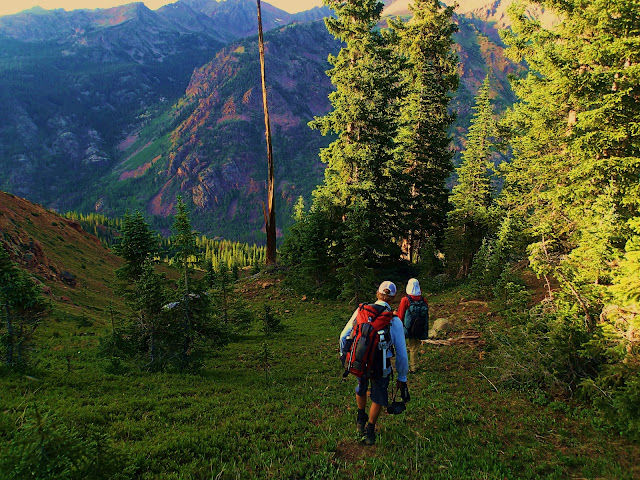
We began on a trail outside of Vail, Colorado, but before long we were off trail in the backcountry.

Liam Doran, our photographer, on the right.



Andrew helping Liam with his “hot spot,” which is where one feels a tingly sensation. The tingly sensation could turn into a blister if not properly treated.

Easily the sketchiest part of our trip was when we had to descend a 35 degree permanent snow field. The snow was hard packed, but we were able to kick hand holds and foot holds for our descent.


On the second night it rained, so we slept beneath two tarps like these. As you can see, Andrew’s trekking poles come in handy.

We slept in our bivy sacks (8 ounces). One’s required to wear his/her hat to bed to provide a buffer zone between one’s face and the mesh, which was buzzing with mosquitoes. While my trip with Andrew enlightened me in many ways, I think, after two rather uncomfortable nights in a bivy, I still favor my roomy one-person tent.


Updated: Mar 4, 2022
To train for my upcoming hike, I hiked for two days in the Ptarmigan Peaks, outside of Dillon, Colorado, between elevations of 9,000 and 13,000 feet. It was the first time I’ve ever hiked at that sort of altitude, and by the end of Day-1, after about 15 miles, I had a raging headache, which forced me to end my day early and set up camp.
I was surprised with how round and bulbous the mountains were. I was expecting razor-sharp ridge lines and towering spires, but I was happy to have nice, hard, flat ground to walk on for the most part. Pictures below…


